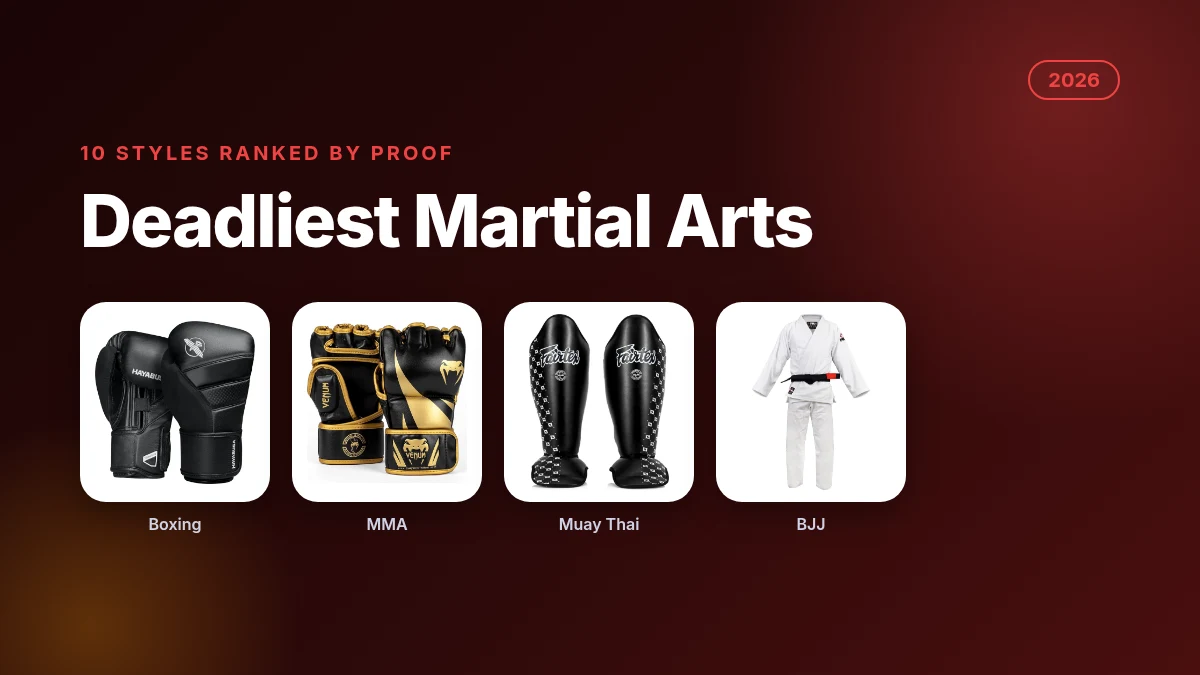
Deadliest Martial Arts: 10 Styles Ranked by Proof (2026)
The deadliest martial arts are not the ones with the scariest names or the most secret techniques. They are the styles that train against fully resisting opponents, have been tested in open-rules fights, and teach skills you can actually use under stress. This guide ranks 10 styles by that proof, then flags the famous ones that fall short.
Quick answer: The deadliest martial arts in 2026, ranked by real-fight proof, are MMA, Muay Thai, Brazilian Jiu-Jitsu, combat sambo and Lethwei, followed by wrestling, boxing, judo, Krav Maga and Kyokushin karate. Each one is trained with hard sparring or full-contact competition, which is the single best predictor of what works in a real fight.
What are the deadliest martial arts in 2026?
The deadliest martial arts in 2026 are MMA, Muay Thai, Brazilian Jiu-Jitsu, combat sambo and Lethwei, with wrestling, boxing, judo, Krav Maga and Kyokushin close behind. They rank highest because practitioners spar against resisting partners and compete under rules that allow real damage, so the techniques are proven rather than theoretical.
The Deadliest Martial Arts Proof Table (our ranking, 2026):
| Rank | Martial art | Origin | Range | Live sparring? | Open-rules proof | Brutality of ruleset (1-5) | Our proof score (out of 5) |
|---|---|---|---|---|---|---|---|
| 1 | MMA | Modern hybrid (UFC 1, 1993) | Striking + clinch + ground | Yes, every class | Built from open-rules fights | 4 | 5.0 |
| 2 | Muay Thai | Thailand | Striking + clinch | Yes | Core striking base in MMA | 4 | 4.8 |
| 3 | Brazilian Jiu-Jitsu | Brazil (from judo) | Ground + chokes | Yes, rolling every class | Royce Gracie won UFC 1 | 3 | 4.8 |
| 4 | Combat sambo | Soviet Union | Striking + throws + ground | Yes | Khabib Nurmagomedov, 2x combat sambo world champion | 5 | 4.7 |
| 5 | Lethwei | Myanmar | Striking + headbutts | Yes | Bareknuckle full-contact bouts | 5 | 4.5 |
| 6 | Wrestling | Worldwide | Takedowns + control | Yes | Top MMA base for control | 2 | 4.5 |
| 7 | Boxing | Worldwide | Punches | Yes | Proven striking in every ruleset | 3 | 4.4 |
| 8 | Judo | Japan (1882) | Throws + ground | Yes, randori | Olympic since 1964 | 3 | 4.3 |
| 9 | Krav Maga | Israel | Self-defense scenarios | Varies by gym | Military origin, little open competition | 5 | 3.9 |
| 10 | Kyokushin karate | Japan (1964) | Kicks + punches | Yes, knockdown rules | Full-contact tournaments | 4 | 3.9 |
The brutality column rates how much damage each style’s training or competition rules allow. The proof score weighs live sparring, open-rules results and real-world transfer more than brutality, which is why Lethwei and Krav Maga do not top the list even though their rules are the harshest.
How did we rank the deadliest martial arts?
We ranked each martial art on four tests: whether students spar against fully resisting partners, whether the style has been proven in open-rules fights such as early UFC events, how much damage its rules allow, and how well skills transfer to a real confrontation. Live sparring carries the most weight.
The sparring rule is not just opinion. A 2015 study of Dutch police officers published in Ergonomics found that officers with extra martial arts training, including kickboxing, karate or jiu-jitsu and krav maga, performed better in arrest and self-defense scenarios under high anxiety than officers with only regular police training (Renden et al., 2015). Even officers who trained once a week did better. Training under pressure is what makes a style dangerous.
The scores are editorial ratings out of 5, built from public history, rules and competition records. They are not a promise of what happens in any one fight. Size, fitness, weapons and multiple attackers change everything, and the safest outcome in a real confrontation is usually avoiding it.
Why is MMA the deadliest martial art overall?
MMA is the deadliest martial art overall because it combines the best striking, clinch work, takedowns and ground fighting from other styles, then tests them all in full-contact fights. It came out of open-rules events where any style could enter, so techniques that failed were dropped and techniques that worked stayed.
The first UFC event took place on November 12, 1993, in Denver, Colorado, as an eight-man tournament between different styles (UFC 1). That format grew out of Brazil’s vale tudo, a fighting format with very few rules that eventually evolved into modern MMA (Vale tudo). Three decades of those fights acted as a filter: today almost every pro fighter trains striking, wrestling and jiu-jitsu together.
For a street situation, MMA’s biggest edge is that you train every range. If someone grabs you, you know the clinch. If you end up on the ground, you know how to get up or take control. Our guide to the best martial arts for MMA breaks down which base styles combine best.
Why does Muay Thai rank as the deadliest striking art?
Muay Thai ranks as the deadliest striking art because it uses fists, elbows, knees and shins, which is why it is called the Art of Eight Limbs. Fighters condition their shins and spar hard, and the clinch lets them land knees and elbows at close range where most other striking styles stop working.
Muay Thai is a Thai full-contact combat sport built on stand-up striking, sweeps and clinching (Muay Thai). Elbows cut, knees end fights in the clinch, and low kicks can take a leg away in seconds. That is why so many MMA fighters use it as their striking base.
The tradeoff is that Muay Thai has no ground game. If a fight goes to the floor, a pure Muay Thai fighter is on unfamiliar ground. Pair it with jiu-jitsu or wrestling and the gap closes.
Why is Brazilian Jiu-Jitsu considered so dangerous?
Brazilian Jiu-Jitsu is considered dangerous because it teaches you to take a fight to the ground, reach a dominant position and finish with chokes or joint locks. A blood choke can make someone lose consciousness in seconds, and BJJ students practice these finishes at full resistance in almost every class.
BJJ was developed by the Gracie brothers around 1925, after Carlos Gracie was taught judo in 1917 by Mitsuyo Maeda or one of Maeda’s students (Brazilian jiu-jitsu). Its reputation exploded at UFC 1, where Royce Gracie won the tournament by submitting Gerard Gordeau with a rear naked choke.
The weakness is that sport BJJ does not train strikes, and rolling on concrete with an attacker’s friends nearby is very different from rolling on mats. Good self-defense gyms teach takedown defense and getting back to your feet, not only guard play.
Is combat sambo deadlier than regular sambo?
Yes, combat sambo is deadlier than sport sambo because it was developed for the military and adds striking to the throws and leg locks. Combat sambo allows punches, kicks, elbows, knees, soccer kicks and headbutts on top of wrestling and submissions, so it covers more damage than almost any sport ruleset.
Sambo has Soviet origins and was recognized as an official sport on November 16, 1938, by the USSR All-Union Sports Committee (Sambo). Sport sambo looks like jacket wrestling with leg locks. Combat sambo is the full version.
Its best-known product is Khabib Nurmagomedov, a two-time combat sambo world champion who retired from the UFC undefeated at 29-0 as the longest-reigning UFC lightweight champion (Khabib Nurmagomedov). Dedicated sambo gyms are rare outside Eastern Europe, so most people get similar skills from wrestling, judo and MMA classes.
Is Lethwei the most brutal martial art in the world?
Lethwei is widely called one of the most brutal martial arts in the world because fighters compete bareknuckle with only tape and gauze, and headbutts are legal. Its nickname is the Art of Nine Limbs, adding the head to Muay Thai’s fists, elbows, knees and shins, and traditional rules allow a timeout to revive a knocked-out fighter.
Lethwei, also called Burmese boxing, comes from Myanmar and uses kicks, knees, elbows, punches and headbutts (Lethwei). Under traditional rules, each corner gets one two-minute timeout per fight to revive a fighter who has been knocked out, which says a lot about how hard these bouts are.
It ranks fifth rather than first because it is a pure striking art with almost no gyms outside Myanmar, and its brutality is mostly about the ruleset. Anyone who can survive Lethwei sparring is dangerous, but Muay Thai gives you about the same toolkit with far more places to learn it.
Are wrestling, boxing and judo deadly in a real fight?
Yes, wrestling, boxing and judo are very effective in a real fight because all three are trained with full resistance every session. Wrestling controls where a fight happens, boxing delivers the fastest knockout tools, and a judo throw onto hard ground can end a confrontation before it really starts.
Wrestling is the most underrated base on this list. Wrestlers decide whether a fight stays standing or goes down, and that control is why so many MMA champions started on the mat. It does not teach strikes or submissions, so it ranks behind BJJ and sambo.
Boxing has the best hands in combat sports. Footwork, head movement and short, sharp punches work in any ruleset. Boxers do not train kicks, takedowns or ground fighting, which is the main thing holding it back here.
Judo was created in 1882 by Kano Jigoro and stood out from older jujutsu schools by focusing on live randori rather than only set forms (Judo). It became the primary martial art of the Tokyo Metropolitan Police Department after winning police tournaments, and it has been an Olympic sport since 1964. Being thrown onto concrete is far more dangerous than being thrown onto a mat.
Is Krav Maga really one of the deadliest martial arts?
Krav Maga is one of the most aggressive self-defense systems, built for the Israel Defense Forces and focused on real-world threats, groin strikes and weapon defenses. It ranks ninth here because quality varies widely between gyms, and many schools spar far less than Muay Thai, BJJ or boxing gyms do.
Krav Maga was developed by Imi Lichtenfeld, who used his background as a boxer and wrestler to defend Jewish neighborhoods in Bratislava in the mid-to-late 1930s, then taught combat training to the groups that later formed the IDF (Krav Maga). Its mindset of ending a threat fast and escaping is exactly right for self-defense.
The catch is that techniques aimed at eyes, throat and groin cannot be practiced at full speed on a partner, so some gyms rely on drills that never meet real resistance. A good Krav Maga gym adds pressure testing and sparring. Ask to watch a class before joining.
Why does Kyokushin karate make the list?
Kyokushin karate makes the list because it is a full-contact style where fighters throw real punches to the body and kicks to the legs, body and head in knockdown tournaments. It is far tougher than point-sparring karate, and its conditioning culture produces fighters who can take and deliver heavy damage.
Kyokushin Kaikan was founded in 1964 by Masutatsu Oyama and has spread to more than 120 countries (Kyokushin). Knockdown rules usually ban punches to the face, which is the big gap for street use, so Kyokushin students who add boxing or Muay Thai sparring become very dangerous strikers.
Which famous deadly martial arts are overrated?
Ninjutsu, touch-of-death techniques and many secret military systems are overrated because they are rarely, if ever, tested against fully resisting opponents. A style can teach dangerous ideas, but without hard sparring nobody knows if those ideas work under stress, so they rank below every style in our table.
- Touch of death (dim mak): the idea of killing someone with a light strike to a special point is a legend, not a trainable skill (Touch of death).
- Ninjutsu: historically it described the skills of covert operatives in pre-modern Japan, including espionage and infiltration (Ninjutsu). Modern schools rarely hold open full-contact competition.
- Pencak silat: a real and respected class of Indonesian martial arts that UNESCO added to its Intangible Cultural Heritage list in December 2019, with strikes, grappling, throws and weapons (Pencak silat). Quality depends heavily on whether a school spars.
- Systema: a Russian martial art whose schools appeared after the Soviet Union ended, with many teachers claiming their own versions (Systema). Look for schools that spar.
The rule of thumb is simple: if a gym says its techniques are too deadly to spar, that usually means they have never been tested.
Which deadly martial art should you actually learn?
Learn Muay Thai, BJJ, boxing or MMA if you want skills that work in a real fight, because those gyms are easy to find and every class includes live sparring or rolling. Pick MMA if you want all ranges in one place, or combine one striking art with one grappling art over time.
Which deadly martial art fits your goal (our picker):
| Your goal | Start with | Add next | Why |
|---|---|---|---|
| Best all-round fighting skill | MMA | Extra BJJ classes | Covers every range in one gym |
| Hit hardest standing up | Muay Thai | Boxing | Elbows, knees and kicks plus sharp hands |
| Control bigger attackers | BJJ | Wrestling or judo | Leverage, chokes and getting on top |
| Fastest useful skill in 3 months | Boxing | Muay Thai | Simple, repeatable, sparred early |
| Military-style self-defense mindset | Krav Maga (gym that spars) | BJJ | Threat awareness plus a tested ground game |
| Full-contact karate tradition | Kyokushin | Boxing | Toughness plus face punching for street use |
If your main goal is protecting yourself rather than chasing the scariest style, read our full ranking of the best martial arts for self defense, which weighs safety, cost and how fast skills arrive. To find a real gym, use our checklist for MMA classes near me.
What gear do you need to start training a deadly martial art?
Many striking and MMA gyms expect beginners to bring their own gloves, hand wraps, shin guards and a mouthguard once they sign up, while most BJJ and judo gyms need a gi for most classes. Buying your own gear is more hygienic than loaner equipment and usually fits better.
Start with the gear your chosen style uses every class:
- MMA: a pair of open-palm training gloves for bag work and sparring. See our picks for the best MMA gloves.
- Muay Thai and kickboxing: shin guards for sparring so you can kick and check kicks safely. Compare the best Muay Thai shin guards.
- Brazilian Jiu-Jitsu and judo: a durable gi that survives hard grips and frequent washing. Our guide to the best BJJ gis and gi brands covers beginner-friendly options.
- Every style: a fitted mouthguard and hand wraps for any striking class.
Buy the core piece first, train for a few weeks, then add the rest once you know you will stick with it.
Frequently Asked Questions
What is the deadliest martial art in the world?
MMA is the deadliest martial art overall because it combines striking, wrestling and submissions and tests them in full-contact fights. Among single styles, Muay Thai, Brazilian Jiu-Jitsu, combat sambo and Lethwei are usually named as the most dangerous, with Lethwei having the harshest rules thanks to bareknuckle fighting and legal headbutts.
What is the most dangerous martial art for a street fight?
For a street fight, the most dangerous styles combine striking and grappling, such as MMA or Muay Thai plus BJJ. Avoiding the fight is still the safest choice, because weapons, multiple attackers and hard ground make any confrontation unpredictable even for trained fighters.
Is Krav Maga deadlier than MMA?
Krav Maga teaches more brutal techniques, such as groin and eye strikes, but MMA fighters spar their techniques at full resistance far more often. In most head-to-head matchups the better-trained, harder-sparring person wins, so MMA ranks higher here. A Krav Maga gym that spars closes much of that gap.
What is the deadliest martial art in Japan?
Judo and Kyokushin karate are the most proven Japanese martial arts, since both are trained with live resistance. Judo, created in 1882, became the Tokyo police department’s main martial art, and Kyokushin is a full-contact karate style founded in 1964. Ninjutsu is famous but rarely tested against resisting opponents.
Can you learn a deadly martial art at home?
You can learn basics, footwork and conditioning at home, but you cannot learn to fight without live sparring partners and a coach. Use home training to support classes, not replace them. A home bag, gloves and mobility work help you improve faster between sessions at the gym.