Filipino Martial Arts: Arnis, Eskrima and Kali Explained (2026)
Filipino martial arts, often shortened to FMA, are best known for one thing that makes them different from almost every other style: you pick up a weapon on day one. Where karate or taekwondo save weapons for black belts, arnis, eskrima and kali start with sticks and blades and then show you that the same movements work with empty hands.
This guide explains what Filipino martial arts are, why they go by three different names, where they came from, how training works, the major systems you will see on school websites, and how to get started wherever you live.
Quick answer: Filipino martial arts are the fighting systems of the Philippines, known as arnis, eskrima (escrima) and kali. They are weapons-based arts built around the stick, the blade and empty-hand techniques that follow the same angles and footwork. They are practical for self defense, cheap to start, and suit people of almost any age and size.
What Are Filipino Martial Arts?
Filipino martial arts are a family of combat systems that developed across the more than 7,000 islands of the Philippines. There is no single official style. Instead there are hundreds of family and regional systems that share a common core: weapons first, angles of attack, constant movement, and an emphasis on flow and adaptability.
In 2009 the Philippines passed Republic Act 9850, which made arnis the country’s official national martial art and sport. Today it is taught in Philippine schools, practiced in tournaments around the world, and trained by police and military units who value its focus on edged weapons and close-quarters defense.
Arnis vs Eskrima vs Kali: What Is the Difference?
The three names are mostly regional and historical labels for the same family of arts. A school’s choice of name usually tells you more about its lineage than about what it teaches.
| Name | Where It Comes From | What It Usually Signals |
|---|---|---|
| Arnis | Luzon (northern Philippines); from the Spanish “arnes”, meaning armor or harness | The official national sport; common in Modern Arnis and school programs |
| Eskrima / Escrima | The Visayas (central Philippines, including Cebu); from the Spanish “esgrima”, meaning fencing | Cebuano systems such as Doce Pares, Balintawak and Serrada |
| Kali | Popularized in the United States; its origin is debated | Schools linked to Dan Inosanto, Pekiti-Tirsia or Jeet Kune Do |
In practice, an arnis class in Manila, an eskrima club in Cebu and a kali program in California will all have you swinging sticks, drilling angles of attack and practicing disarms. The differences come from the specific system and teacher, not the name on the door.
A Short History of Filipino Martial Arts
Filipino fighting arts long predate Spanish rule. The most famous early story is the Battle of Mactan in 1521, when the chieftain Lapu-Lapu and his warriors defeated the Spanish expedition led by Ferdinand Magellan, who was killed in the fighting.
During more than 300 years of Spanish colonization, the arts survived and blended with outside influences. Spanish fencing terms crept into the vocabulary, and many historians believe the arts were practiced quietly or hidden inside folk dances and stage plays. Later, Filipino soldiers and guerrillas relied on blade skills during the Philippine-American War and World War II.
In the 20th century the arts organized and spread. The Doce Pares club was founded in Cebu in 1932. Filipino immigrants carried their systems to Hawaii and California, and Angel Cabales opened one of the first public eskrima schools in the United States in Stockton in the 1960s. Dan Inosanto, a training partner of Bruce Lee, then brought FMA to a much wider audience, and Hollywood fight choreography has leaned on it ever since.
The Weapons of Filipino Martial Arts
FMA is often described as “weapons first”, and the main weapon categories shape the whole curriculum. For a wider look at traditional tools across many styles, see our guide to martial arts weapons.
The Stick (Baston or Olisi)
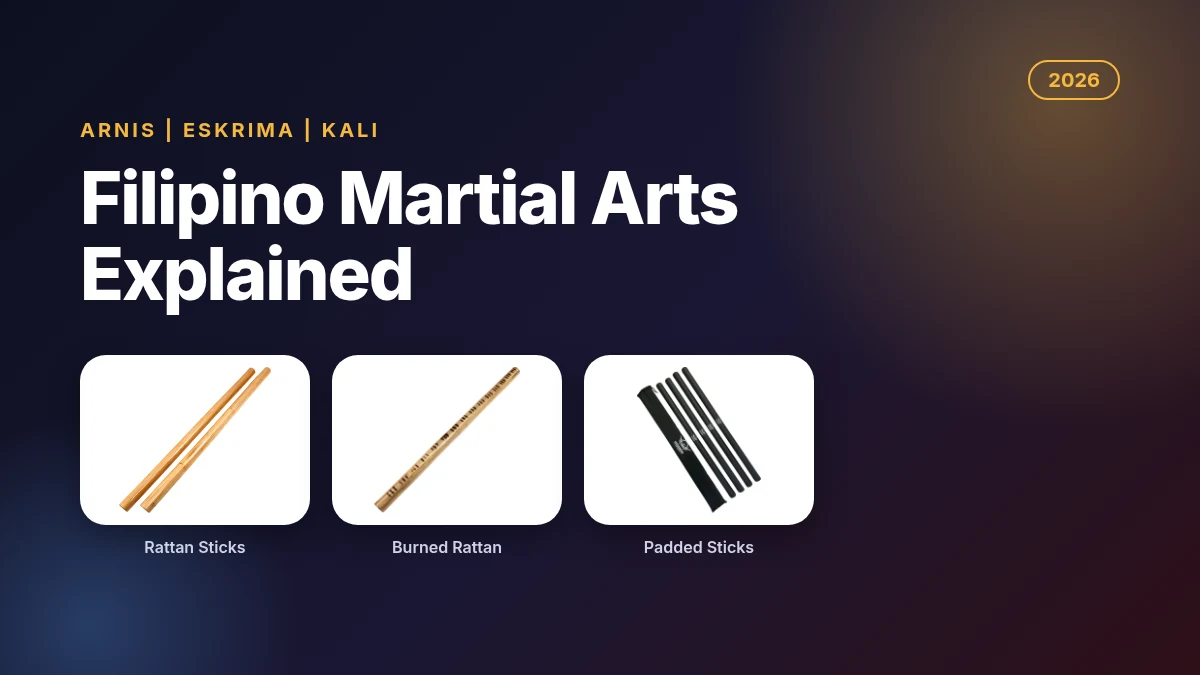
The rattan stick, usually around 26 to 28 inches long, is the signature training tool. Rattan is light, tough and tends to splinter rather than shatter, which makes it safer for partner drills. Students train single stick and double stick (doble baston), and many systems treat the stick as a stand-in for a blade.
The Blade
Bladed weapons are at the heart of most systems: long blades like the bolo, barong and kampilan, and short blades like the daga (dagger). In training, students use blunt aluminum, wood or rubber trainers, never live blades.
Espada y Daga
“Sword and dagger” training pairs a long weapon in one hand with a short weapon in the other. It teaches both hands to work at the same time, a skill that carries over directly to empty-hand fighting.
Empty Hands
Most systems include empty-hand work, often called mano mano or by specific names: panantukan or suntukan (Filipino boxing with elbows, head control and limb destruction), sikaran (kicking) and dumog (clinch work and grappling). The angles and footwork are the same ones students learned with the stick.
How Filipino Martial Arts Training Works
FMA classes look different from most other martial arts classes. Expect lots of partner work, rhythm and repetition, and less time spent on forms.
- Angles of attack: most systems teach a numbered set of strikes, commonly 12, that cover every line of attack. Students learn to strike and defend each angle.
- Sinawali: rhythmic double-stick weaving drills that build coordination, timing and ambidexterity.
- Flow drills: partner drills like hubud-lubud and sumbrada that train counters and counter-counters at speed.
- Disarms and locks: taking an opponent’s weapon and controlling the arm, a core FMA skill.
- Footwork: triangle patterns and angling off the line of attack, so you are never standing still in front of a weapon.
- Sparring: from light padded-stick sparring to tournament formats with armor and, in some groups, full-contact stick fighting.
Beginners typically spend the first months learning basic strikes, blocks, a few drills and safe partner practice. Because the drills are cooperative at first, newcomers can train with experienced students from day one.
Major Filipino Martial Arts Systems
You will see these names often when you search for schools.
| System | Known For |
|---|---|
| Doce Pares | Cebu-based eskrima founded in 1932; strong tournament scene and a complete stick, blade and empty-hand curriculum |
| Modern Arnis | Created by Remy Presas; blends arnis with joint locks and is famous for its accessible teaching style |
| Pekiti-Tirsia Kali | A blade-focused system of the Tortal family, spread worldwide by Grand Tuhon Leo Gaje |
| Inosanto Kali | Dan Inosanto’s blend of several FMA systems, often taught alongside Jeet Kune Do |
| Balintawak | Cebuano single-stick system known for close-range fighting and fast reflex training |
| Serrada Eskrima | Angel Cabales’s close-quarters system, rooted in Stockton, California |
| Kombatan | Ernesto Presas’s broad system covering sticks, blades and empty hands |
| Lameco Eskrima | Edgar Sulite’s combat-focused system that blends several masters’ teachings |
Are Filipino Martial Arts Good for Self Defense?
Filipino martial arts have a strong self defense reputation, and for good reason. They train you to deal with weapons, which most sport-focused arts ignore, and they build reflexes, footwork and awareness of angles that carry over to unarmed situations. Many self defense instructors and law enforcement trainers use FMA concepts for edged-weapon awareness.
There are two caveats. First, the best real-world training includes live, resisting practice, so look for a school that spars at least some of the time. Second, FMA focuses on striking and weapons, so many people pair it with a grappling art. If you are comparing your options, our guide to the best martial arts to learn breaks down where each style shines.
Benefits of Training FMA
- Practical skills: weapon awareness, footwork and quick reflexes that apply to real situations.
- Coordination: double-stick drills train both hands equally, which improves ambidexterity.
- Fitness: constant movement and fast drills give a solid cardio and shoulder workout.
- Low barrier to entry: you need very little gear, and size and strength matter less than timing.
- Lifelong art: many FMA masters keep training well into their seventies and beyond.
- Culture: you learn a living piece of Filipino history and heritage.
How to Find a Filipino Martial Arts Class
FMA schools are smaller and less common than BJJ or karate gyms, but they exist in most large cities. Search for “arnis”, “eskrima”, “escrima” and “kali” along with your city, because each school uses its own name. Also check martial arts gyms that teach Jeet Kune Do or MMA, since many offer kali classes on their schedule, and look for seminar listings from the big systems above.
When you visit, ask about the instructor’s lineage, watch a full class, and ask whether the school spars. A good FMA school will happily explain its system and let you try a class before you commit.
Gear You Need to Start Training
One of the best things about FMA is how little gear you need. Many schools lend sticks for your first few classes, but most students soon buy their own. A pair of rattan sticks is the classic first purchase, and padded sticks are a great addition for safe sparring and home practice with a partner.
Padded escrima sticks let you practice full-speed strikes and light sparring without the bruises. This Martial Arts Armory 4-pack includes four 26 inch foam sticks with a PVC core and a carry bag, so you and a partner each get a pair. It is rated 4.5 out of 5 by more than 350 Amazon buyers.
Once you start blade work, a blunt aluminum training knife lets you drill disarms and knife defense safely with a realistic weight. This Ring to Cage aluminum trainer is 11 inches long with a paracord-style grip.
For harder sparring, add a fencing-style or padded head guard and padded gloves. Your instructor will tell you what the school requires, so ask before you buy protective gear.
Frequently Asked Questions
Is arnis the same as eskrima and kali?
Mostly, yes. Arnis, eskrima and kali are different names for the Filipino martial arts. The name a school uses usually reflects its region or lineage, while the specific system and teacher matter more for what you will learn.
Is Filipino martial arts effective?
Yes. FMA is widely respected for weapons defense, footwork and close-range striking, and its concepts are used in self defense and law enforcement training. Like any art, it works best when the school includes pressure testing and sparring.
How long does it take to learn Filipino martial arts?
Most students learn the basic strikes, blocks and drills in a few months of regular training. Reaching an instructor level usually takes several years, depending on the system and how often you train.
Can kids learn Filipino martial arts?
Yes. Many schools run kids’ classes using padded sticks, which keeps training safe while building coordination, focus and confidence.
Do Filipino martial arts include empty-hand fighting?
Yes. Most systems teach empty-hand striking (panantukan or suntukan), kicking and clinch work, built on the same angles and footwork students learn with sticks and blades.
What is the national martial art of the Philippines?
Arnis. Republic Act 9850, signed in 2009, declared arnis the national martial art and sport of the Philippines.
Final Thoughts
Filipino martial arts offer something few other styles do: practical weapon skills from your very first class, a deep cultural history and training that stays fun for decades. Whether a school calls it arnis, eskrima or kali, you will learn to move well, react fast and handle sticks, blades and empty hands with the same set of principles. If you like the idea of a practical, culturally rich art, you might also enjoy reading about Brazilian martial arts and how they compare.
Ready to start drilling at home or with a training partner? A set of padded sticks is the easiest first step.