
How Long Does It Take to Get Good at Boxing? A Realistic Timeline (2026)
Short answer: most people need 3 to 6 months of coached training, two to four sessions a week, to get good at boxing basics and start light sparring. Feeling like you can hold your own in gym sparring usually takes 1 to 2 years, and looking like a real competitor takes 2 to 4 years. Train once a week and every number roughly doubles.
Last updated: October 26, 2026. By Chris, editor at Martial Arts Rankings, who covers boxing training, gear and fight sports for beginners. Timelines below come from boxing coaches, the USA Boxing rulebook and research on how practice turns into skill.
Every boxing forum has the same thread on repeat: “I’ve been going three times a week for a month and I still feel like a total noob. How long did it take you?” The answers range from “six weeks” to “I’ve been boxing ten years and I’m still bad,” which is both honest and useless. This guide turns that into a real timeline: what you can do at each stage, how training frequency changes the math, when sparring and competing usually start, and a simple self-check so you can tell if you are actually improving.
How Long Does It Take to Get Good at Boxing?
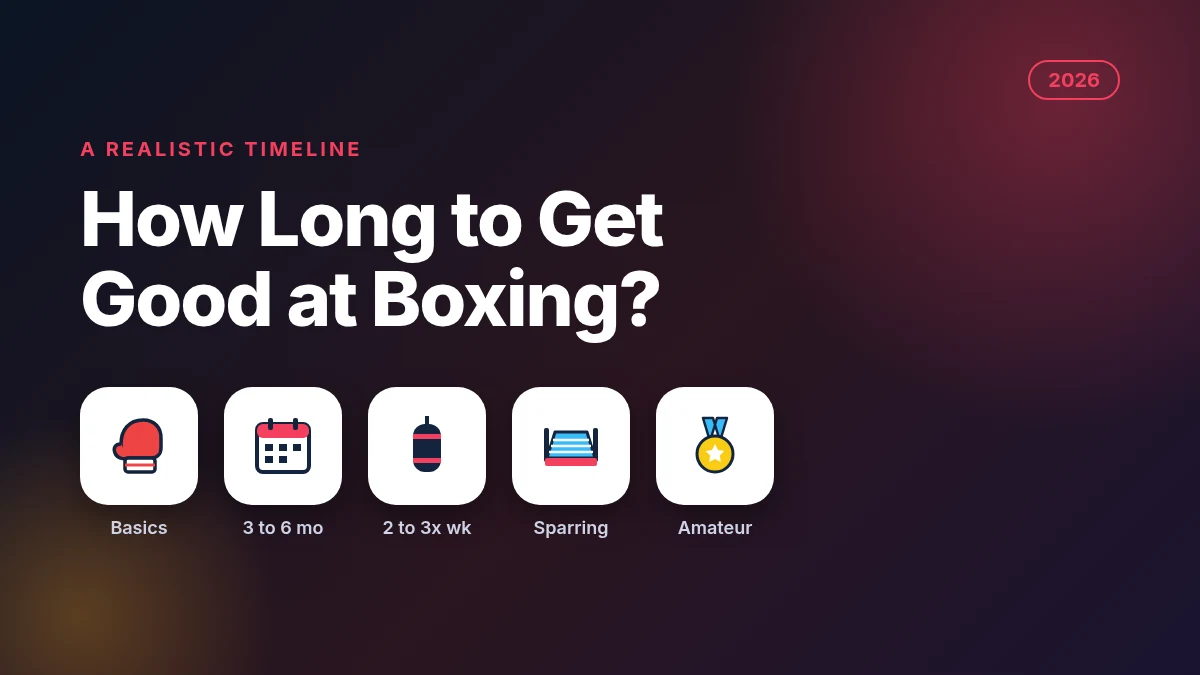
Expect about 3 to 6 months to get good at the basics, meaning a solid stance, a guard that stays up, clean jab-cross combinations and basic defense. Being comfortable in light sparring takes 6 to 12 months, holding your own against most gym regulars takes 1 to 2 years, and competitive amateur level usually takes 2 to 4 years.
“Good” means different things at each stage, so it helps to split it up. Coaches tend to agree on the early milestones. Windy Fight Gear says its coaches get beginners to basic boxing, defined as a stance you hold without thinking, a guard that stays up and a jab-cross with proper weight transfer, in about 8 to 12 weeks of coached training two to three times a week (Windy Fight Gear). Ironhand Boxing’s head coach puts most beginners into light, controlled sparring between three and six months (Ironhand Boxing). After that, the timeline depends far more on sparring, coaching and consistency than on the calendar.
What Can You Do After 1, 3, 6 and 12 Months of Boxing?
After one month you know your stance, jab, cross and how to wrap your hands. By three months you throw all six punches in combinations with basic defense. Around six months most boxers start light technical sparring. By twelve months you spar regularly, think less about single punches and start building a style.
| Time training (2 to 4 sessions a week) | What you can realistically do | What still feels hard |
|---|---|---|
| Weeks 1 to 4 | Stance, basic footwork, jab and cross, wrapping hands, surviving bag rounds | Keeping your hands up when tired, breathing |
| Months 1 to 3 | All six punches, simple combinations, blocks and slips on pads | Defense and offense at the same time |
| Months 3 to 6 | Combinations under pressure, mitt work, first light sparring | Staying calm when someone hits back |
| Months 6 to 12 | Regular technical sparring, basic ring movement, cutting angles | Body shots, counterpunching, pacing a round |
| Years 1 to 2 | Hold your own with most gym regulars, maybe a first bout | Adjusting to different styles and southpaws |
| Years 2 to 4 | Competitive amateur level, a recognizable style | Everything, at a higher level |
The first few weeks are humbling for nearly everyone. People who arrive thinking they can throw a punch find out fast that throwing one with balance, from a guard, and getting back to that guard, is a different skill. That “I’m a total noob” feeling is normal at week three and mostly gone by month two.
How Does Training Frequency Change the Timeline?
A lot. Training once a week roughly doubles the time to learn the basics, from about 8 to 12 weeks to 4 to 6 months, because coordination fades between sessions. Two to three coached sessions a week is the sweet spot for most beginners. Four or five helps only if you recover well and spar sensibly.
Windy Fight Gear makes the same point: at once a week, the gap between sessions gives new coordination time to fade before the next rep locks it in. More is not always better, though. Beginners who jump to daily hard sessions tend to get sore wrists, sore shoulders and sloppy technique. Here is how the milestones shift with frequency.
The Boxing Skill Timeline by Training Frequency
| Milestone | 1 session a week | 2 to 3 sessions a week | 4 to 5 sessions a week |
|---|---|---|---|
| Solid stance, guard and jab-cross | 4 to 6 months | 8 to 12 weeks | 6 to 8 weeks |
| First light technical sparring | 9 to 12 months | 3 to 6 months | 2 to 4 months |
| Comfortable in regular gym sparring | 2 years or more | 6 to 12 months | 6 to 9 months |
| Ready for a first amateur bout (coach’s call) | Rarely reached | 9 to 18 months | 6 to 12 months |
| Hold your own with experienced amateurs | Rarely reached | 2 to 4 years | 2 to 3 years |
These ranges combine coach estimates from the sources above with the typical progressions coaches describe. Treat them as averages for an adult beginner at a decent gym, not promises. Athletic background, age, coaching quality and how often you spar all move the numbers.
How Long Before You Can Spar in Boxing?
Most beginners at a well-run gym start light, controlled sparring after 3 to 6 months of consistent training. Your coach decides, usually once you keep your guard up when tired, defend a jab, stay calm under pressure and can control your own power. Hard sparring comes much later, and some gyms never do it with beginners.
Sparring is where boxing skill really compounds, because pads and bags do not hit back. But it is also where bad gyms hurt people. A good first sparring session looks like slow, technical rounds with a more experienced partner who is helping you learn, not a test of toughness. Start with restricted drills, like jab only or one partner attacking while the other defends, then open it up gradually. If a gym throws brand new members into hard sparring in week one, that is a red flag, not a shortcut. For the foundation everything builds on, read our boxing stance guide.
How Long Does It Take to Be Ready for an Amateur Fight?
Usually 9 to 18 months of steady training with regular sparring, and always your coach’s call. In USA Boxing you compete as a novice until you have 10 bouts, with open class from the 11th, so your first fights are against other inexperienced boxers. You also need a USA Boxing membership and a pre-bout medical check.
The novice and open split comes from the USA Boxing rulebook, and many Golden Gloves tournaments use the same 10-bout line. That structure means “ready to compete” does not mean “ready to beat everyone”. It means you can defend yourself, keep your shape for three rounds and follow your corner. Many people box for years and never compete, which is completely fine. If you do want to fight, you will also be matched by weight, so check our boxing weight classes guide to see where you land.
How Long Does It Take to Learn Boxing for Self Defense?
A few months of coached training gives you a real edge over an untrained person: a guard, a sharp jab-cross and the habit of staying on your feet. Most experienced boxers say it takes 1 to 3 years of regular sparring before skills become automatic under stress. Avoidance and walking away still beat any punch.
The key word is sparring. Bag work teaches you to hit, but only live rounds teach you to see punches coming, stay calm when hit and keep thinking. Boxing also has limits for self defense. It does not cover grappling, multiple attackers or weapons, and bare-knuckle punches to a head can break your hand. If self defense is your main goal, boxing is a strong base, but pair it with some grappling and good judgment.
Why Do Some Beginners Improve Faster Than Others?
Practice matters, but it is not the whole story. A large 2014 meta-analysis found deliberate practice explained about 18 percent of the differences in sports performance. Athletic background, coaching quality, sparring partners, recovery and age explain much of the rest. The fastest improvers train consistently, ask questions and spar with people slightly better than them.
That figure comes from Macnamara, Hambrick and Oswald (2014), which pooled studies across music, games, sports and professions. It is a useful reality check on the “just put in 10,000 hours” myth. Hours matter, but the type of hours matters more. In practical terms, these habits speed things up:
- Get coached reps. Two coached sessions beat four solo ones, because a coach catches errors before they become habits.
- Drill the boring stuff. Jab, footwork and defense drills with a partner pay off for years.
- Shadowbox at home. Three rounds on rest days keeps coordination from fading. A mirror helps.
- Do pad work. Mitts teach timing and combinations in a way bags cannot. Our guide to the best boxing mitts covers what to look for if you train with a partner.
- Spar light and often. Many easy technical rounds beat a few wars.
- Build your engine. Running and skipping rope mean your technique survives round three.
- Film yourself. Ten seconds of video shows the dropped hand you swear you do not have.
The 10-Point “Am I Getting Better?” Check
Score yourself every three months. Each yes is a point.
- My hands come back to my face after every punch.
- I can throw a jab-cross-hook without losing balance.
- I breathe out on punches without thinking about it.
- I can last three hard bag or pad rounds and keep my form.
- I step off the line instead of only backing up.
- I can slip or parry a jab in drills most of the time.
- I stay calm when I get hit in light sparring.
- I can throw to the body as well as the head.
- I notice what my partner is doing, not only what I am doing.
- My coach has stopped correcting the same basic mistake every session.
Under 4 is normal in the first three months. Around 6 to 7 by month six means you are on track. If you are stuck on the same score for six months, change something: more coached sessions, more partner drills or more light sparring.
FAQ: Getting Good at Boxing
Can you get good at boxing in 3 months?
You can get good at the basics in 3 months if you train with a coach two to four times a week. That means a stance, a guard, clean combinations and basic defense. You will not be good at sparring yet, but you will clearly be better than when you started.
Can you learn boxing at home?
You can learn stance, footwork, shadowboxing and conditioning at home, and it helps. But nobody corrects your mistakes, and you cannot learn timing or defense without someone throwing punches at you. Home training works best as an extra to a gym, not a replacement.
How many hours a week should a beginner box?
About 3 to 5 hours, usually two to three classes of 60 to 90 minutes plus some shadowboxing or running. That is enough to improve steadily without wrecking your hands, shoulders or sleep. Add more once your body handles the load.
Is 30 or 40 too old to get good at boxing?
No. Plenty of people start boxing in their 30s and 40s, and many gyms run classes aimed at adults. Progress may be a little slower because recovery takes longer, so prioritize technique, light sparring and rest days. Competing has age rules, but training and fitness boxing do not.
How long does it take to get good at boxing footwork?
Basic footwork, staying in stance while moving forward, back and sideways, takes most people 1 to 3 months. Using footwork well in sparring, cutting angles and controlling distance, takes 1 to 2 years. Footwork usually lags behind punching, so drill it on purpose.
How many years does it take to master boxing?
Nobody really masters boxing. Even professional champions keep training with coaches. Competitive amateur level usually takes 2 to 4 years, and elite amateur or professional level takes much longer plus talent and a lot of fights. Aim to be better than last year, not to finish.


