

Taekwondo vs Karate: Choosing the Right Martial Art (2024)
Thanks for checking out this unbiased article on Taekwondo vs Karate, two of the most popular martial arts globally. Both have rich histories and are steeped in tradition, offering more than just physical exercise.
They provide spiritual enrichment, discipline, and self-defense techniques, catering to a vast audience from all age groups.
Whether you’re considering starting a martial art or looking to switch disciplines, understanding the subtle and not-so-subtle differences between them can significantly impact your choice.
Taekwondo, originating from Korea, emphasizes speed and agility with spectacular high kicks and rapid striking techniques. Conversely, Karate, which comes from Japan, focuses more on hand techniques, deep stances, and powerful, precise movements.
This article dives deep into each martial art’s techniques, benefits, and philosophies to give you a clear perspective on what each offers and how they compare to one another.
Both arts have evolved significantly over the centuries, gaining massive followings worldwide and being featured prominently in international sports competitions, including the Olympics.
Whether you’re interested in the health benefits, self-defense, or competitive aspects, knowing the key aspects of Taekwondo and Karate will help you make an informed decision on which martial art is more suited to your lifestyle and fitness goals.
Join us as we explore the intricate world of these fascinating martial disciplines.
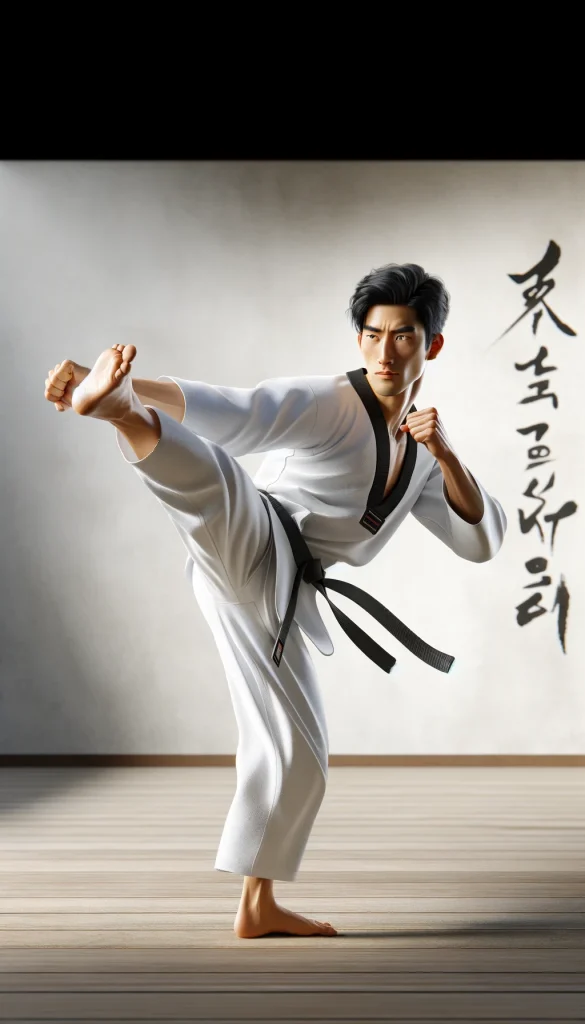
Taekwondo vs Karate: Which is better?
The Fundamentals of Taekwondo
Taekwondo, a martial art that boasts a dynamic and spectacular array of movements, places a strong emphasis on kicks and agility. This section explores the foundational elements of Taekwondo, from its historic roots to the techniques that define its practice today.
History and Development
Taekwondo originated on the Korean peninsula with influences from various fighting techniques. Historical records suggest that the earliest forms of Taekwondo began during the Three Kingdoms of Korea period (57 BC to 668 AD).
Modern Taekwondo was systematized in the mid-20th century, when Korean martial arts masters unified their diverse martial arts practices under a single discipline, which emphasizes both self-defense and philosophical aspects.
Key Principles
Each practice and technique in Taekwondo is guided by five tenets:
- Courtesy (Yeui): A fundamental respect for oneself and others, permeating all areas of life.
- Integrity (Yomchi): Adherence to moral and ethical principles.
- Perseverance (Innae): The commitment to persist and persevere through difficulties.
- Self-control (Gukgi): The discipline it takes to control one’s actions and reactions.
- Indomitable spirit (Baekjeolbulgul): The courage to stand up for what is right.
These principles are not just philosophical teachings but are also integral in the physical application of Taekwondo techniques.
Basic Techniques
Taekwondo techniques are categorized into three main groups:
- Stances (Sogi): The foundation for all Taekwondo techniques, providing balance and flexibility. Examples include the front stance (Ap Sogi) and the back stance (Dwit Sogi).
- Kicks (Chagi): Taekwondo is renowned for its emphasis on kicking, which includes front kicks (Ap Chagi), side kicks (Yop Chagi), and the spectacular spinning hook kick (Huryeo Chagi).
- Blocks and Strikes: These defensive and offensive moves include the high block (Nopunde Makgi), the knife-hand strike (Sonkal Taerigi), and the punch (Jireugi).
Taekwondo Forms (Poomsae)
Poomsae or forms are a set of prearranged movements that simulate combat against an imaginary opponent. Practicing these helps students improve their technique, balance, and mental focus.
Forms range from basic (Taegeuk Il Jang) to advanced (Taegeuk Pal Jang), and each form is more complex than the one before it.
Through the disciplined practice of these forms and techniques, Taekwondo practitioners (taekwondoin) develop not only physical strength and agility but also mental sharpness and ethical integrity.
This holistic development is what sets Taekwondo apart as a martial art and a path to personal betterment.

The Fundamentals of Karate
Karate is a martial art characterized by its focus on striking techniques, including punching, kicking, knee strikes, and elbow strikes. This section delves into the basics of Karate, covering its origins, key principles, and foundational techniques that every practitioner should know.
History and Development
Karate originated from the Ryukyu Kingdom (now Okinawa, Japan) and was heavily influenced by Chinese Kung Fu, as evidenced by the similarity between the two arts’ techniques and forms.
It was systematized in Japan in the early 20th century, where it was blended with Japanese martial arts practices, leading to the styles known today, such as Shotokan, Wado-ryu, Shito-ryu, and Goju-ryu.
Each style emphasizes different aspects of technique, speed, and breath control but follows the same underlying principles.
Key Principles
The philosophical and ethical elements of Karate are encapsulated in two sets of principles, the Dojo Kun and the Niju Kun, which were established to guide practitioners not only in training but in their everyday lives:
- Dojo Kun:
- Strive for the perfection of character.
- Be faithful and sincere.
- Cultivate perseverance.
- Respect others.
- Refrain from violent behavior.
- Niju Kun:
- There is no first strike in Karate.
- There is a distinction between bravery and recklessness.
- Karate supports righteousness.
- First know yourself, then know others.
- Develop a judicious mind.
These principles serve as the moral compass for Karate practitioners, guiding them towards personal and spiritual growth.
Basic Techniques
Karate techniques are designed to turn the human body into a complete self-defense tool, utilizing the following methods:
- Stances (Dachi): Fundamental to all movements in Karate, stances provide the practitioner with stability and balance while performing techniques. Key stances include the front stance (Zenkutsu Dachi), back stance (Kokutsu Dachi), and horse stance (Kiba Dachi).
- Punches (Tsuki): Precision strikes that can be performed from various stances. Common punches include the lunge punch (Oi Tsuki) and reverse punch (Gyaku Tsuki).
- Kicks (Keri): Though less emphasized than in Taekwondo, kicks remain vital in Karate. Basic kicks include the front kick (Mae Geri), roundhouse kick (Mawashi Geri), and side kick (Yoko Geri).
- Blocks (Uke): Defensive techniques that redirect or halt an opponent’s attacks, such as the rising block (Age Uke), outside block (Soto Uke), and inside block (Uchi Uke).
- Kata: Pre-arranged sequences of movements that represent a fight against multiple opponents. Practicing kata is essential for mastering the application of techniques under different scenarios.
Karate Kata (Forms)
Kata are detailed choreographed patterns of movements practiced either solo or in teams. Each kata emphasizes a specific theme in Karate philosophy and incorporates a comprehensive range of movements, from blocking and striking to evasive maneuvers. Examples include:
- Heian Shodan – introduces basic techniques and stances.
- Tekki Shodan – focuses on mastering the horse stance and lateral movements.
- Kanku Dai – encapsulates core principles of Shotokan Karate.
Karate’s structured approach to training, emphasis on precise and powerful techniques, and its philosophical underpinnings not only prepare students for physical engagements but also teach patience, control, and ethical behavior, fostering a comprehensive, disciplined approach to life’s challenges.
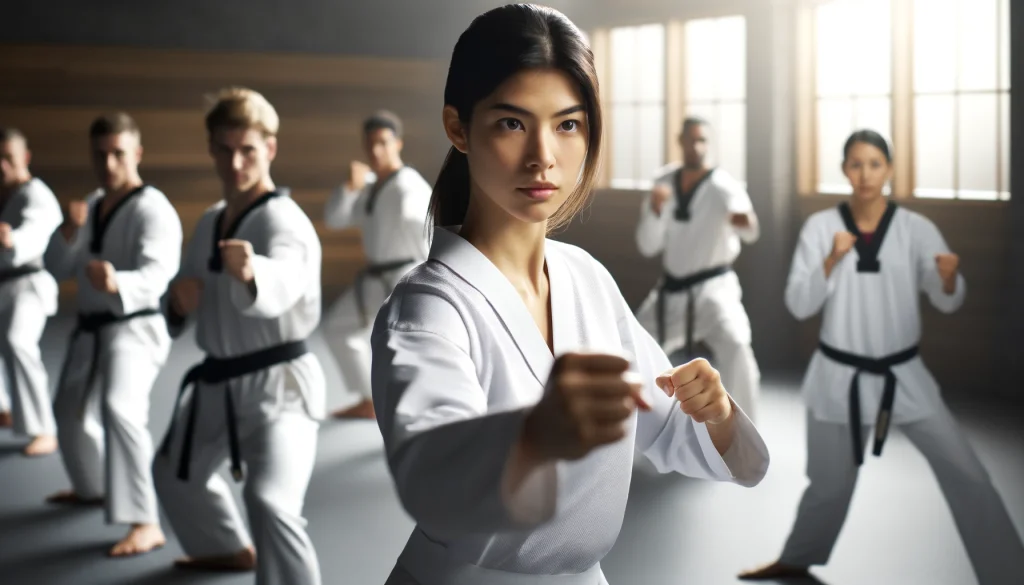
Taekwondo vs Karate: The Techniques Compared
In exploring Taekwondo and Karate, it becomes clear that each martial art features unique techniques that define its practice.
This section compares these techniques in terms of stances, kicks, strikes, and defensive moves, highlighting the distinctive attributes and effectiveness of each martial art.
Comparison of Stances
Stances are fundamental in both Taekwondo and Karate, serving as the foundation from which all other techniques are executed. They differ primarily in their purpose and application:
- Taekwondo Stances:
- Walking Stance (Ap Seogi): Used for mobility and stability, facilitating quick movements and transitions.
- Horse Riding Stance (Juchum Seogi): Provides stability, used for practicing basic techniques and strengthening the legs.
- Karate Stances:
- Front Stance (Zenkutsu Dachi): Emphasizes forward stability and power, common in offensive techniques.
- Back Stance (Kokutsu Dachi): Used for defensive movements, allows for quick and fluid counter-attacks.
These stances not only prepare the practitioner physically but also teach balance and proper body alignment, which are critical for executing higher-level techniques effectively.
Kicking Techniques Unique to Taekwondo
Taekwondo is renowned for its dynamic and high-reaching kicks, which are considered some of the most powerful and spectacular in martial arts. These include:
- Roundhouse Kick (Dollyo Chagi): Involves a rapid turn of the body and a whip-like motion of the leg, useful for both offense and defense.
- Back Kick (Dwit Chagi): Delivered with the back towards the opponent, combining surprise and power.
- Spinning Hook Kick (Huryeo Chagi): A high difficulty kick that targets the head, known for its knockout power in sparring competitions.
Striking Techniques Unique to Karate
Karate focuses extensively on hand techniques and precise strikes. Some of the key strikes include:
- Lunge Punch (Oi Tsuki): A basic yet powerful straight punch thrown from the front stance; fundamental in many kata.
- Reverse Punch (Gyaku Tsuki): A counter punch delivered with the rear hand, exploiting the power and rotation of the body.
- Knife Hand Strike (Shuto Uke): Uses the hand’s edge, targeting vulnerable areas of an opponent’s body, commonly used in defensive scenarios.
Defensive Moves in Both Martial Arts
Both Taekwondo and Karate incorporate a variety of blocks and evasive maneuvers that reflect their philosophical approaches to defense:
- Taekwondo Blocks:
- High Block (Nopunde Makgi): Defends against attacks targeting the head and upper body.
- Low Block (Arae Makgi): Used to deflect low strikes, such as kicks to the abdomen or lower.
- Karate Blocks:
- Rising Block (Age Uke): Primarily used to defend against overhead attacks.
- Outside Block (Soto Uke): Redirects or stops lateral attacks coming from an opponent’s side.
Understanding these techniques and their applications not only enhances a practitioner’s capability in self-defense scenarios but also deepens their appreciation for the tactical and philosophical depth of Taekwondo and Karate.
The choice of whether to pursue Taekwondo or Karate may depend significantly on one’s preference for the types of movements and strategic frameworks emphasized by each martial art.
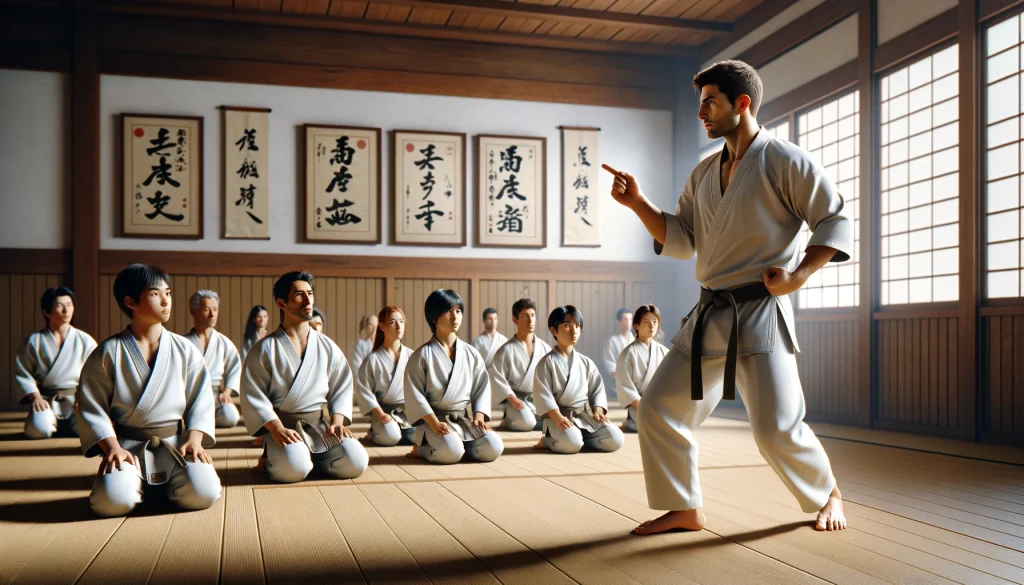
Physical and Mental Benefits
Both Taekwondo and Karate offer extensive physical and mental benefits, shaped by their distinct practices and techniques.
This section will detail these advantages, helping to inform potential practitioners about what they can expect in terms of health and psychological improvements from training in either martial art.
Taekwondo
Taekwondo’s dynamic movements and emphasis on kicks provide substantial physical and mental health benefits.
Physical Health Benefits
- Cardiovascular Fitness: The fast-paced and aerobic nature of Taekwondo drills and sparring sessions enhances heart health and increases stamina.
- Strength Training: Regular training involves a full body workout that strengthens muscles, including the core, and improves muscular endurance.
- Flexibility and Agility: The high kicks and quick movements increase joint and muscle flexibility and enhance body agility.
Mental Health Benefits
- Stress Relief: Physical activity, especially the intense exertion in Taekwondo, helps in reducing stress levels and increasing endorphin production.
- Mental Discipline: Learning and practicing forms (poomsae) and routines improve concentration, memory, and focus.
- Self-Confidence: Mastery of techniques and progressing through belt ranks builds confidence and a sense of achievement.
Karate
Karate’s focused and precise techniques also provide significant health benefits, particularly in terms of mental conditioning and technique mastery.
Physical Health Benefits
- Flexibility: Though less acrobatic than Taekwondo, Karate still offers exercises that enhance flexibility and muscle elasticity.
- Muscle Toning: Karate training involves a lot of repetitive muscle movements which help in toning and building lean muscle.
- Posture and Body Alignment: The stances and movements in Karate improve posture and body alignment, which is beneficial for reducing back pain and other posture-related issues.
Mental Health Benefits
- Concentration and Mental Clarity: The precision required in Karate techniques aids in developing greater focus and mental clarity.
- Self-Awareness: Karate training emphasizes self-awareness — both of one’s body in space and of the opponent’s movements and intentions.
- Respect and Patience: Karate’s Dojo Kun principles instill a sense of respect for self and others, fostering patience.
Through regular practice, both Taekwondo and Karate not only enhance physical fitness and agility but also promote a healthy lifestyle, mental well-being, and psychological resilience.
The discipline and skills gained through these martial arts extend far beyond the dojo and can influence practitioners’ lives in myriad positive ways.
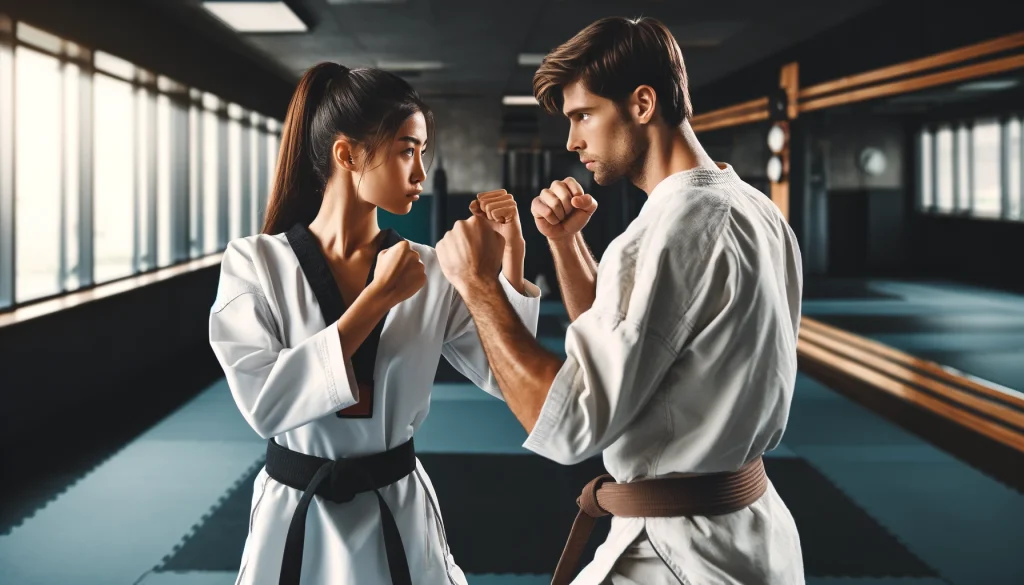
Taekwondo vs Karate: Sporting Aspect
The inclusion of Taekwondo and Karate in the Olympics highlights their global appeal and the competitive nature of these arts.
This section explores their roles in international sports, particularly focusing on the Olympic Games, where the structure, rules, and notable athletes spotlight the disciplines’ unique characteristics and the intense preparation that athletes undergo.
Taekwondo in the Olympics
Taekwondo became an official Olympic sport in the 2000 Sydney Games, reflecting its worldwide popularity and standardized competition rules.
Olympic Competition Rules
- Scoring: Points in Olympic Taekwondo are awarded for techniques delivered to the torso and head. The system uses electronic scoring systems to detect valid strikes, which must be made with sufficient force to register.
- Weight Classes: Competitors are divided into weight classes to ensure fairness. Men’s and women’s divisions each have four weight classes.
- Match Format: A match consists of three two-minute rounds with a one-minute break between rounds. The winner is the athlete who scores the most points across the three rounds.
Notable Olympic Taekwondo Athletes
- Jade Jones (Great Britain): Two-time Olympic gold medalist in the women’s -57 kg category, known for her speed and strategic use of front leg techniques.
- Steven Lopez (USA): A pioneering figure in Olympic Taekwondo, Lopez won three Olympic medals (two golds and one bronze) across different Games, influencing the sport’s techniques and training methodologies globally.
Karate’s Inclusion in the Olympics
Karate was included in the Olympics for the first time in 2020 during the Tokyo Games, a significant recognition of its cultural and athletic value.
Olympic Competition Rules
- Scoring: Karate in the Olympics features two disciplines: Kata and Kumite. Kata is judged on form and accuracy of movements, while Kumite scores are based on the impact, precision, and timing of techniques.
- Weight Classes: Kumite competitors are divided into weight classes, similar to Taekwondo, to ensure competitive parity.
- Match Format: Kumite matches are three minutes long for men and two minutes for women. The athlete with more points at the end of the bout wins.
Notable Olympic Karate Athletes
- Ryo Kiyuna (Japan): Specializing in Kata, Kiyuna is known for his precise and expressive performances, which have earned him numerous international titles including a gold medal at the Tokyo Olympics.
- Sandra Sánchez (Spain): She won the